
Intro
Having a sound defensive system and gameplan is cruicial, but just as important is finding that right players to fit that system. This guide should provide some clarity on how to recruit defensive players correctly. Special Teams recruiting will also be covered.
This video walks you through what we will discuss in this post. It breaks down minimum roster requirements and individual player tendency types, but I ignore those as attribute and rating info matters way more.
Minimum Roster Requirements
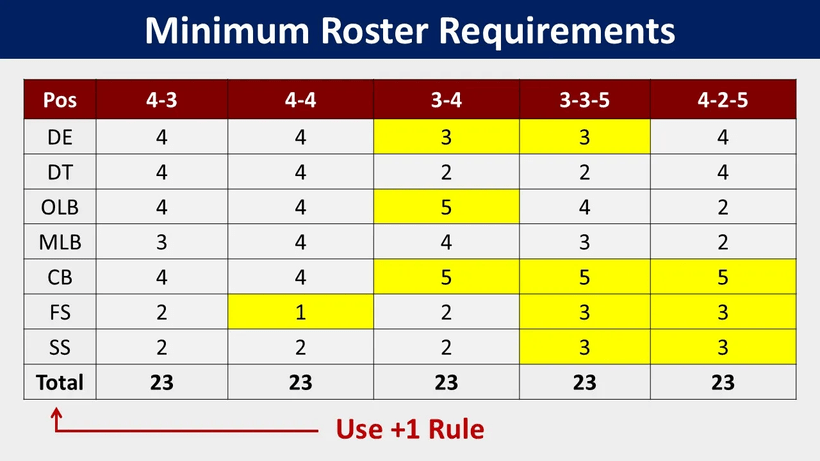
Things get a little more weird on defense when it comes to roster requirements. The totals are the same at 23 like offense which is fine. What isn’t fine are some odd choices for minimums for certain positions shown above in yellow.
- You should need at least 2 FS for the 4-4.
- You should need 4 DE, only 4 OLB, and only 4 CB for the 3-4.
- You should need 4 DE, only 4 CB, only 2 FS, and at least 4 SS for the 3-3-5.
- You should need only 4 CB, only 2 FS, and at least 4 SS for the 4-2-5.
Two DEs play at all times so having at least one backup for your starters is needed. Why five OLBs are needed for a 3-4 makes no sense either. The 3-3-5 and 4-2-5 have it the worst. Simply moving a few of defensive back numbers around would have made things better.
Hopefully, you see why knowing these minimum requirements will make roster management and recruiting much easier. 70 always felt like a perfect amount to keep a deep roster. But for schemes that have goofy requirements, just stay ahead of the minimums and you will be fine. This goes for any scheme you pick.
Attributes & Ratings
We will be talking about attributes and ratings a bunch so it helps to understand what they are and how they relate to eachother. The chart below shows every attribute you will see on a prospect info screen. Each one relates to a player rating. Some are more obvious than others, but this goes a long way in finding the right players to fit your defensive system. Focus on the everything in green below.

Below is a chart showing several ratings and how they convert to certain attributes for most, if not all of the NCAA Football games for the Playstation 2 & Xbox. As far as I know, these ratings are the same for NCAA Football 2002-11 but I can’t confirm this. I do know they are compatible for NCAA Football 06 & 07. This info originally came from someone who gave it to Evil Dave which is on his NCAA Football 07 Recruiting Guide.
I have tested and proofed many of these ratings, but it is possible something maybe off one point or so. This chart is best used to see what how good prospects will be when you recruit them. Speed (SPD), jump (JMP), strength (STR), tackle (TKL), run blocking (RBK), and break tackle (BTK) attributes are shown. Other attributes like catch (CTH) are position specific so I hope to provide those conversions in the future among any others I can configure.

Defensive End – DE, LE, RE

Natural DEs are some of the toughest players to recruit for two reasons:
- Most are weaker than linebackers who can play DE just as well, if not better.
- Bigger DEs for odd front defenses like the 3-4 are few and far between.
The top DEs in each class are spectacular, but many are undersized and weak as sauce. Fear not, you can find the right players to fit any scheme.
All info given in preseason recruiting is enough to decipher if a player fits what you need, for all defesnive positions. Since many natural DEs are limited as mentioned above, you must pay attention. Their height and weight are listed which is key, their 40 Time and strength numbers are shown too.
Pick faster DEs for even front defenses like the 4-3 and much bigger and stronger DEs for odd fronts like the 3-4.
I will go ahead and say this now: linebackers tend to make better DEs due to being stronger and just as big as many natural DEs. We will talk about this more when we cover those positions.

4.65 40 Time or better is great for pass rushers, and any size or strength he has is icing on the cake. This prospect is a unicorn who excellent in all key numbers. He can even be an odd front DE despite only weighing 268. Most odd front DEs need to be closer to 300 if possible but again, very rare. And of course, good awareness never hurts.
Defensive Tackle – DT

This might be the most underrated position on defense, and you can never have enough of them. You can treat them no differently than offensive linemen: big and strong is the way to go. As mentioned earlier, you have everything you need to find the right DTs as both size and strength are shown which are priorities.

Regardless of scheme, a DT’s main job is to plug up A and B gaps while also keeping Centers and Guards at bay. Odd front defenses need even bigger and strong DTs, but any defense can use one that is around 300lbs and strong as an ox like this prospect. You will see plenty of undersize DTs that might have more strength than you realize too which tend to work best in even front defenses.
Outside Linebacker – OLB, LOLB, ROLB

In most defenses, OLBs are assigned to blitz off the edge, make tackles around the line, and cover defenders in space. That is a lot to ask, but speed and awareness is needed for most of that. Prioritize speed, but finding OLBs that are strong as doesn’t hurt either as Squat translates to the Tackle rating which is huge for OLBs. I think Awareness is important for most positions and since OLBs have many responsibilities, there is no reason why you shouldn’t prioritize it too. All of that is there to see as shown above.

Finding someone like this is rare. He’s huge, super fast, very smart, and quite strong for that position. This guy can make a good pass-rushing DE. Any LB that is over 230lbs with a 500+ Squat can do well at DE. MLBs fit this mold even better. But for OLBs, this guy is a future All American.
Middle Linebacker – MLB

MLBs are probably the most important players to recruit since they translate so well to other positions while also being great at their own. As mentioned earlier, bigger stronger MLBs can make great DEs, but they can also make great OLBs. As with all defensive positions, everything is here to find what you need. Recruit way more MLBs than you need since again, they can play multiple positions. Notice the high Squat numbers for the ones listed above. That strength translates. Like an OLB, the biggest, strongest, fastest, and smartest players you can find, the better.

This prospect can fit in any offense. He’s smart and fast enough to play any LB position. He’s also big and strong enough to play DE. Grab as many of these guys as possible. You will notice many smaller MLBs but if they are fast and smart enough, they can still make good LBs.
Cornerback – CB

CBs in this game don’t translate to any other position on defense well but are amazing at CB as they should be. I’ve ran many types of defenses in this game, but I stick to the same type of CB: fast and tall. I need CBs that can keep up with WRs and the taller they are, the better chance that can defend jump ball situations. Vertical Jump isn’t shown but height is.

This prospect has everything I need. Anybody 6 feet or taller is great, and his 40 Time is off the charts. His Vertical Jump is fantastic too, icing on the cake, just like his amazing awareness. Notice his Hands. Yes, this translates to him making more interceptions, but CBs can sometimes make decent WRs too in a pinch.
Free Safety – FS

I recruit Free Safeties no differently than CBs. I need the tallest and fastest guys I can find as they defend deep more than anything else. Their most crucial plays will come on the backend so having great safety valves are crucial. Everything is here to find the right FS. These tend to be slower than CBs, but any fast and tall guys I can find, the better. Awareness is even more important so they know when to look up and defend a jump ball situation.

This prospect is a unicorn, crazy tall and fast for his position. Good luck getting anything past him.
Strong Safety – SS

These guys tend to be a hybrid of FS and an OLB. You will notice how stronger they are than FSs but smaller than OLBs. SSs are used differently in various schemes. Many of mine cover deep, defend the box, and chase offensive players if needed. Like with all defensive positions, all info needed is shown above. Speed helps regardless, but the bigger stronger ones are needed more if you use them to play closer to the line.

This prospect can thrive in any defense. Big enough to play down low and fast enough to cover deep. Again, it comes down to what you need the most. Great numbers across the board never hurt.
Athletes
Athletes are the great enigma when it comes to recuiting. Some of the best players I’ve had were Athletes. They come in all shapes and sizes and can only be recruited in the offeseason. You won’t know what position fits them best until you get to Position Changes, but let’s look at a few examples for ones that might play defense. You will notice how I highlight and focus on basically all info given for Athletes.
The Big Tweener

Athletes who weigh between 250-280 are more than likely TEs or Defensive Ends (DE). However, notice how there is no Hands attribute which makes it more clear he probably plays on defense. He could also be a very undersized offensive linemen.
Big Boys

Any Athlete who weighs around 300lbs is probably an offensive linemen or a DT. I’ve noticed over the years that these guys tend to be better DTs but not always.
The Unknown

Perhaps the most popular type of Athlete, these are harder to tell what position they are best at. For example, this prospect might be a CB, FS, SS, HB, or WR. Any Athlete around this size can work anywhere, even good at multiple positions, not just one.
Kickers and Punters – K & P

Kickers and punters can only be recruited in the offseason, but are very simple to recruit. Only two attributes matter: Kick Power and Kick Accuracy. It’s very simple: the higher the better as you see with this prospect. Unfortunately, there aren’t a ton of kickers and punters to choose from, and are usually only interested if you have none on your roster.
What about Potential & Discipline?
To be honest, I rarely look at these as the hard numbers matter more. Potential is nice as you can see if a player can progress faster than others. Discipline is random though. An A+ Discipline player can still get in trouble.
Position Changes

This chart gives a nice rundown of defensive position changes. The most important thing to remember is NOT to move first-year prospects until after their first season. Their ratings can get wonky and plummet.

